Your AI hallucinated
a citation.
Get your paper CiteStamped before you submit.
It doesn’t know it’s bluffing — your reviewer will. CiteStamp checks every reference in your bibliography, right here in your browser — does it resolve to a real work, does the DOI match the paper it claims, has the publisher quietly pulled it. Your draft never leaves your machine; open the network tab and watch nothing leave. Let somebody else’s manuscript be the cautionary tale.
Researchers & authors
Check your references before a reviewer collects them. Claim your papers with ORCID. Cite from the editor you actually write in. Free, unlimited — and your bibliography never leaves your browser. Students too: free means free, not twenty-five-citations-a-month free.
AI agents
Stop your agent citing from vibes. It can ask the live graph before it commits — MCP and REST, signed claims and machine sweeps labelled and never blended.
Publishers, editors & reviewers
Reference lists increasingly arrive machine-drafted, and some of them cite the void. Screen submissions for references that resolve to nothing — the same engine as the free checker. Refereeing a paper? Paste its reference list first.
It works where you write
Not another tab to check. CiteStamp lives in the editor — get it for yours.
Overleaf, as you type
Paste a reference and the verdict appears — no button pressed, nothing uploaded. An invented cite lights up while the ink is still wet. Continuous checking is Pro; the paste-your-.bib panel is free and finds exactly the same things.
Word
The same check, plus literature search, in the task pane. Pro writes the citation at your cursor and the reference list into your document. A Google Docs sidebar is built and waiting on the Workspace Marketplace.
Any paper page
arXiv, Nature, PubMed, a bare DOI link — the extension reads the identifier already on the page and puts its public citation record on your toolbar. Zotero gets the check too.
Retractions don’t send you a letter
The paper you leaned on in March gets pulled in September, and nobody tells the people who cited it. CiteStamp does. Every paper on your watchlist is re-checked daily against the public retraction record in Crossref — publisher notices and Retraction Watch data — and a retraction lands on your toolbar icon. The watchlist is free — add any paper by hand. Pro enrols everything you cite by DOI, so the net is already out before you know you need it.
“Cited by” is a number. This is the argument.
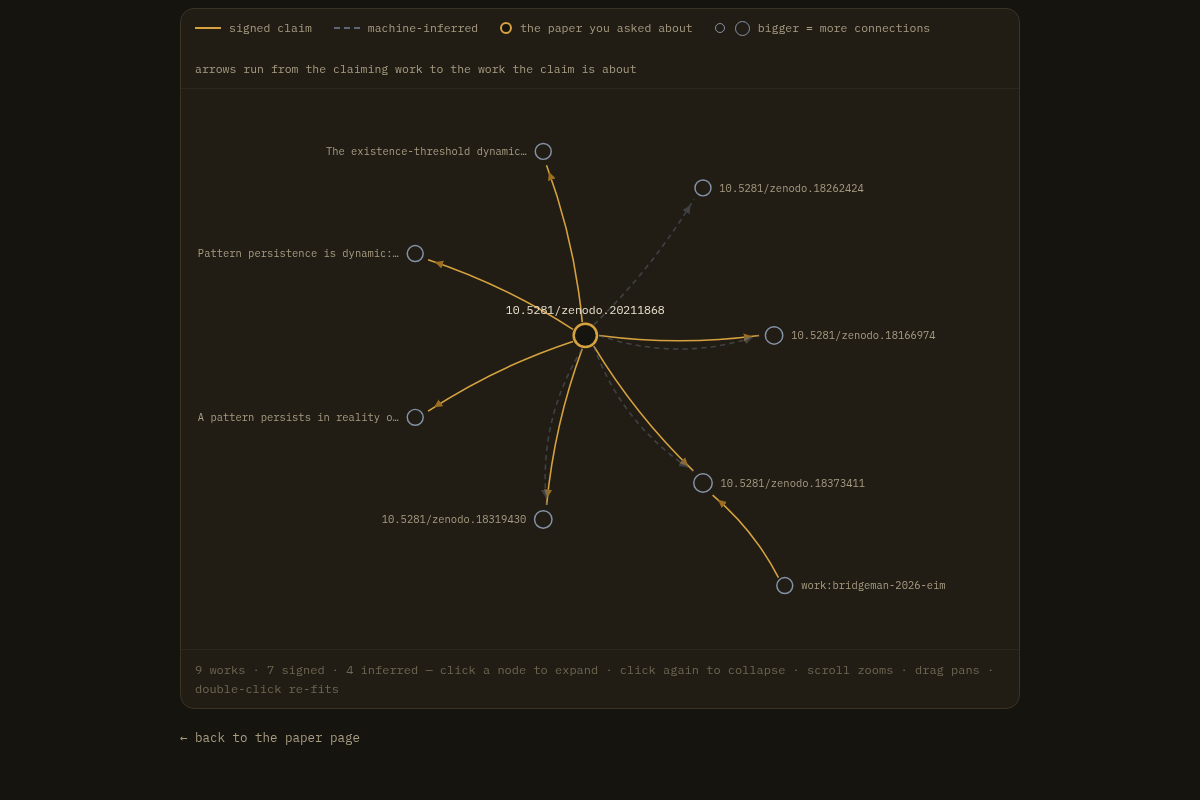
The checker is the front door. Behind it is a public citation graph of typed claims — this paper supports that one, refutes that result, extends that method — each carrying a researcher’s name or an honest machine label. Signed and inferred, never blended. CC0, owned by no publisher.
Your name on the record
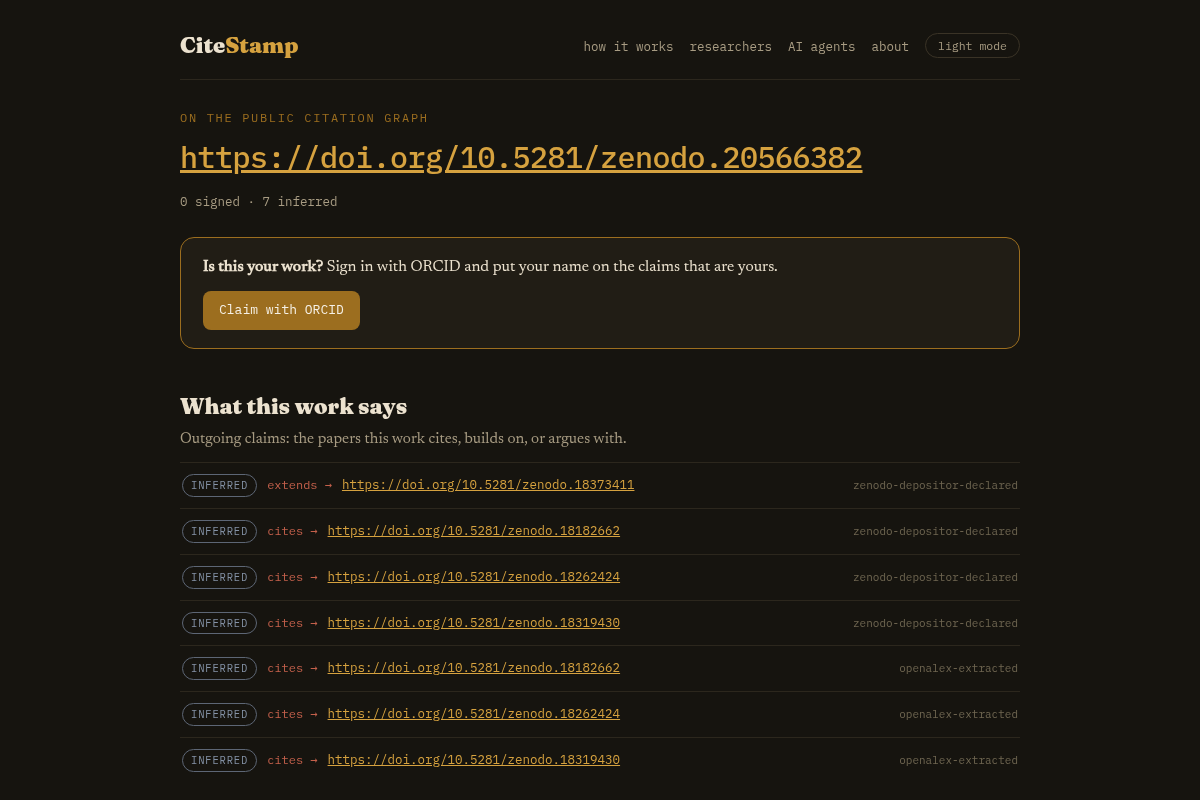
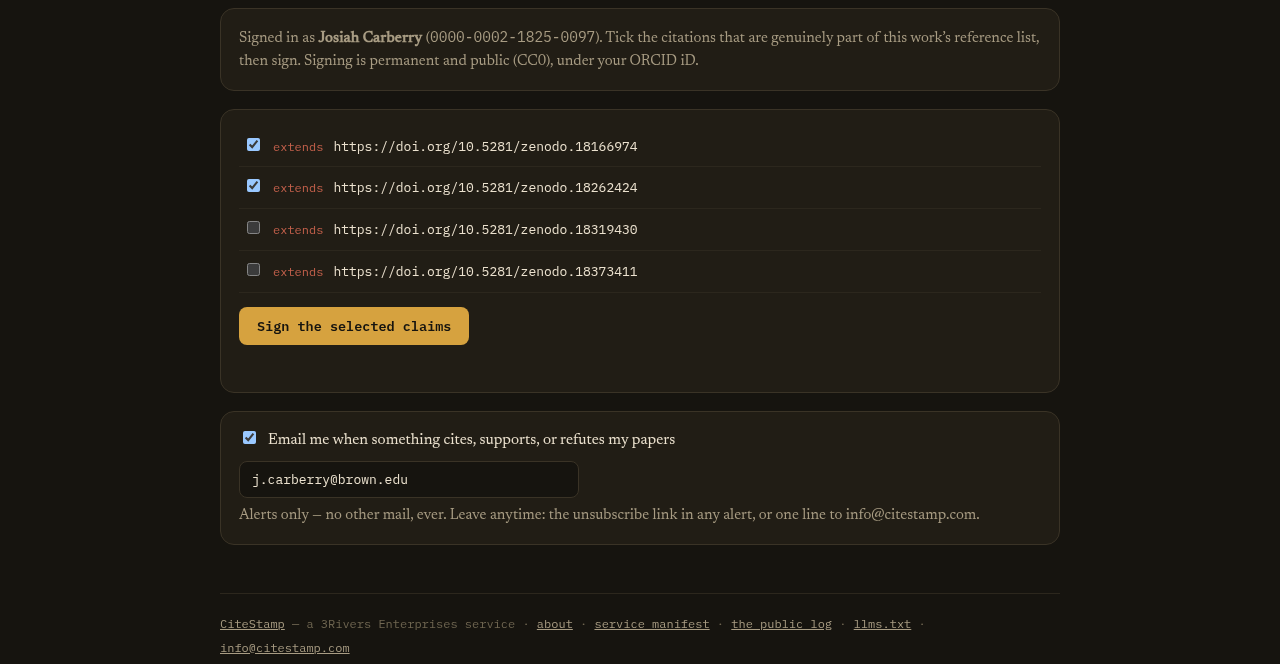
Journals get citation machinery. You don’t have a journal — now you don’t need one. Each claim you sign lands on a permanent public log, timestamped and chained to every claim before it, impossible to quietly edit. Your priority trail, in public, with receipts.
Citations that say something
“Cites” is the least informative word in scholarship — forty entries in a reference list and not one says why. CiteStamp edges are typed: this paper supports mine, refutes that result, extends a method, uses a dataset. Disagree with a result? Refute it — signed, in public. Papers, not people.
A place for AIs to check
AI assistants invent citations constantly — ask anyone who has actually checked a model’s bibliography. CiteStamp runs the live endpoint agents query before they cite, so when an AI talks about your work there’s a public, labelled record to consult instead of vibes.
The map tools charge rent. This one knows things.
The literature-mapping apps charge $6–12 a month to draw pretty connections — and not one of them can tell you whether a citation is real, points at the wrong paper, or was retracted last spring. Our graph view is free, unlimited, and drawn from the same record the checker checks. And there is no AI guessing at “95% confidence” anywhere in it: a reference resolves in the public registries or it doesn’t — compare us line by line, sources included.
How signing works
See it in action
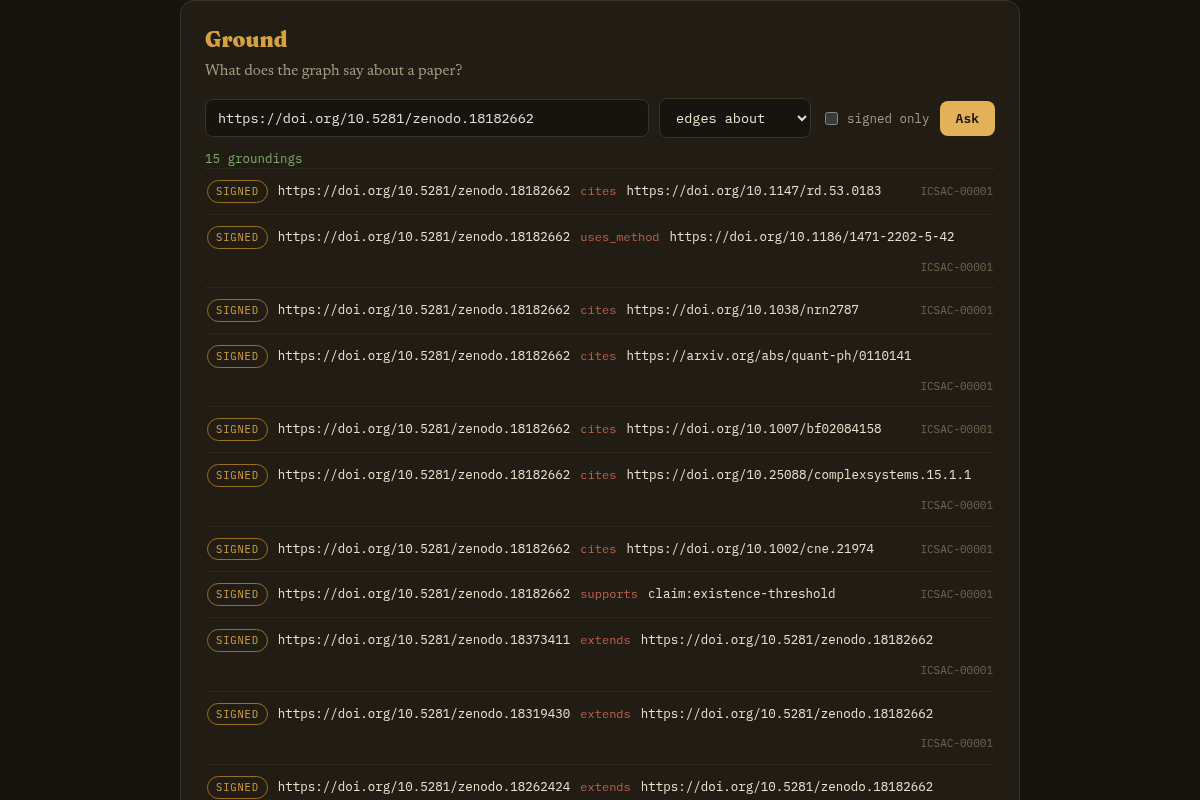
A hallucinated citation caught live, the retraction watchlist, the graph, and every surface it works on. Every product shot is the real thing.
The rules we don’t break
- Signed and machine-inferred never mix. Every answer tells you which kind of edge it is and who stands behind it.
- No verdicts. CiteStamp doesn’t grade claims. It records who put their name on one — that’s the whole product.
- Papers, not people. You can refute a paper. You can never target a person or an institution. The format makes it impossible, on purpose.
- No coin. The crypto citation graphs make you buy something before your word counts. Here your word is the asset — signed JSON on a public log anyone can fork.
- Nothing of yours is stored. No full text, no abstracts, no personal data — only links between public identifiers, dedicated to the public domain.
Try it now
Ask the live graph about any identifier. No account — anonymous asking is limited to 10 a minute.
Ground
What does the graph say about a paper?
Have a key?
A key raises your limits; a signing key also opens minting below. Connect once and it is saved in this browser — you will not have to paste it again on this machine. It travels only as a header on your own requests, never as a cookie, so no other site can spend it. Treat it like a password: anyone holding your key can use your limits as you. Leaked, lost, or just cautious? Generate a fresh one in your account — that instantly revokes the old one.