How a claim gets on the record
Every identifier in the graph has a public page and a map you can walk. What fills that map is claims: a paper supports another, refutes a result, extends a method. Some carry a researcher’s name and some carry a machine label, they are never mixed, and once a signed one is on the append-only log nobody gets to quietly edit it. Including us.
The graph has two kinds of edges — and they never mix
Signed
Put on the record by a named researcher under their ORCID iD, cryptographically signed, and appended to a public chained log. The signed tier is young: its early claims are largely the founder seeding the mechanism on his own papers, disclosed on each claim page.
Inferred
Machine sweeps of open scholarly metadata. Useful coverage, labelled as machine work, and a snapshot that inherits the errors of the metadata it was built from. Today’s coverage lives here.
Every answer CiteStamp gives carries a tier. The two coexist on every paper page, and nothing ever silently promotes one to the other.
Signing your own citations
Claiming a paper that is already in the graph
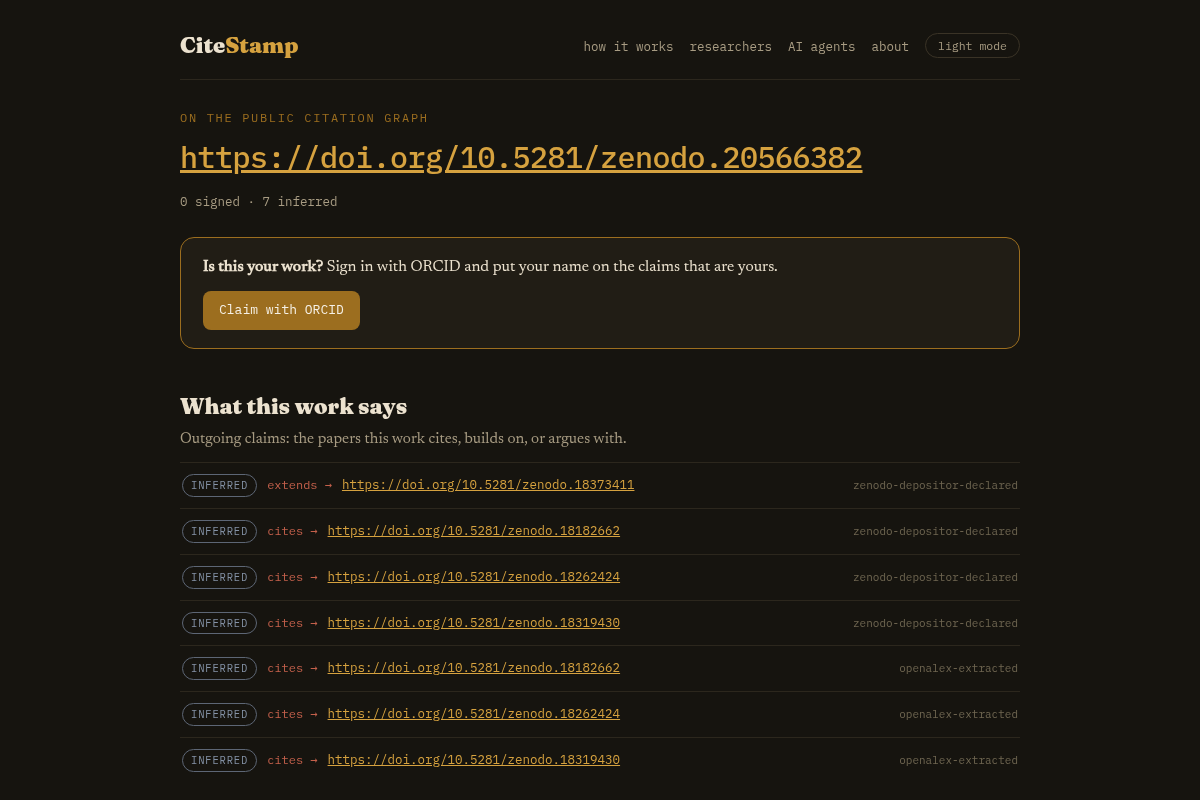
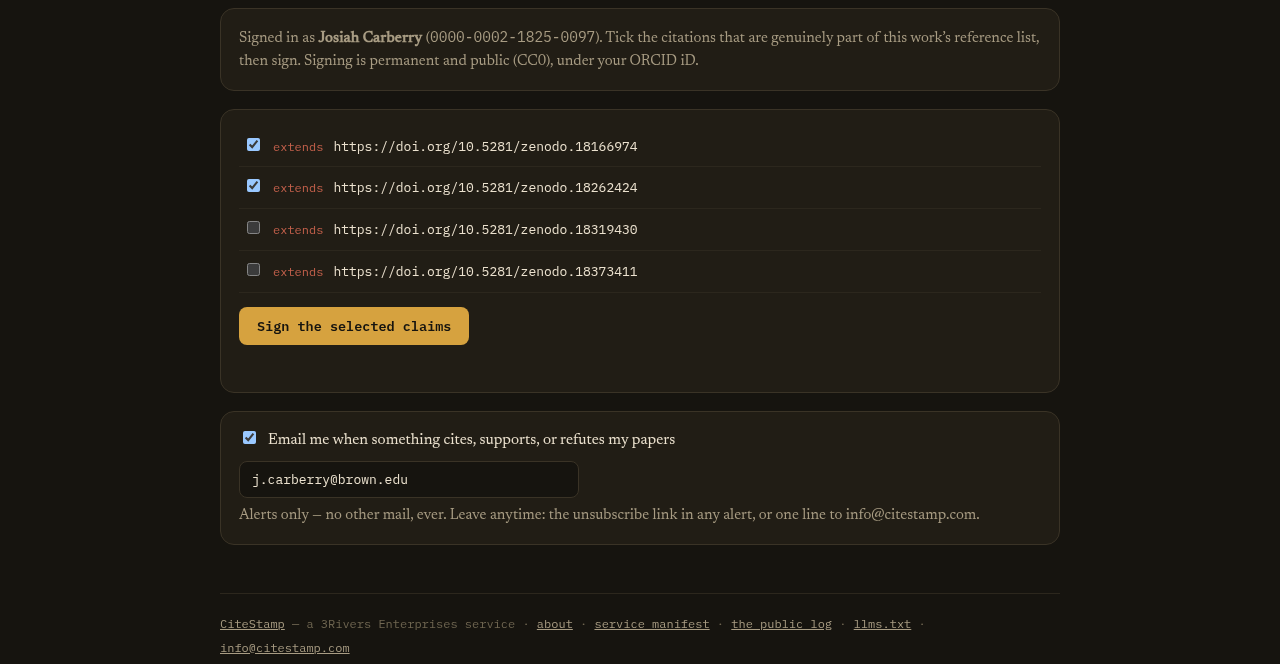
Machine sweeps have already mapped citations for hundreds of thousands of papers. If one of them is yours, open its page and follow Claim with ORCID. You sign in with your ORCID iD, tick the citations that are genuinely part of your reference list, and sign them under your name. Signing in proves who you are; whether the paper is yours is checked against the work’s own public metadata — and when the metadata doesn’t list your iD, a human curator reviews the claim instead. Nothing is ever auto-approved on a name match.
Retraction is public too
Signed something in error? A retraction is itself a signed, public event on the same log — the original line stays, the retraction points at it, and every reader sees both. That is what an append-only record means.